Four thousand two hundred dollars sitting in your account, and only three hundred of it is actually yours to spend. Not because the bank made a mistake. The number on your screen is completely accurate. The problem is what your brain does with that number the moment you see it.
Balance versus safe to spend
A bank balance records activity under the bank's rules. It doesn't know your rent is due Friday, that a card payment clears next week, or that your insurance premium hits in three months. It just shows you one lump sum, and one lump sum feels like one pool of spendable money, even when that pool is secretly doing four or five different jobs at once. Some of it is rent. Some of it is utilities. Some of it is a subscription you forgot about. Some of it hasn't even shown up yet, sitting as a pending charge or a scheduled transfer that hasn't cleared.
Why alerts arrive too late
Low-balance alerts help, but they only react to what's already in your account. A warning that fires after the money has gone is useless, because it arrives too late to stop the purchase that caused the problem in the first place. What you need is a warning that also counts the bills still on their way.
Calculating your safe-to-spend number
So what's the fix? It's a number your banking app doesn't hand you — and the one SmartSpend AI was built around: your safe-to-spend amount. Take your available balance. Subtract every bill you're committed to before your next payday. Subtract planned transfers and irregular expenses you know are coming. Then subtract a personal buffer, just in case. What's left is the only number that should actually guide today's spending decisions.
Let's run it with real figures. Start with that $4,200 balance. Take away $1,800 for rent. Take away $650 for a card payment. Take away $420 for utilities and insurance. Take away $500 for groceries and transport until the next paycheque lands. Take away $300 that's been set aside for irregular costs. And take away a $230 buffer for the unexpected. What's left? $300. That's the number that should actually inform whether you buy something today — not the $4,200 staring back at you from the app.
Irregular expenses aren't surprises
Those irregular costs deserve their own spotlight, because they're often the real surprise attack on a budget. Insurance premiums, car repairs, school expenses, gifts, annual memberships. They don't show up every month, so they don't feel like they're part of the monthly math. But they're not surprises. They're predictable costs on an unpredictable schedule. The trick is converting them into a monthly sinking-fund amount — a little set aside every month — so that when the annual bill lands, the money's already been quietly waiting for it instead of ambushing your chequing account.
The hidden-bills blind spot
Notice that pending transactions, the ones your bank actually warns you about, aren't even the biggest risk here. The bigger blind spot is the obligation that hasn't entered the banking system yet at all: the bill you know is coming but hasn't been charged, the expense you're aware of but haven't accounted for. Your bank can't warn you about a debt it doesn't know exists yet. But the pattern is usually sitting in your past statements already: the same insurer on the same day every month, the phone bill that always lands on the 18th. That rhythm is what SmartSpend AI looks for, so a bill that hasn't been charged yet still shows up on its calendar.
Separating your money
So how do you actually separate this out in practice? It doesn't require anything fancy. Some people use separate buckets within one account. Some open a second account just for bills. Some just keep a running ledger of what's already spoken for. The method doesn't matter. What matters is breaking the illusion that every dollar in that one balance is equally available, when really some of it already has a name on it.
A three-number dashboard
Think of it as a three-number dashboard instead of one. The bank balance tells you what's physically in the account right now. The committed money tells you what's already spoken for. And the safe-to-spend number tells you what you can actually use today without setting off a chain reaction next week.
Letting SmartSpend AI do the walk
Working this out by hand is worth doing once, but it's fiddly, and it goes stale the moment a new bill lands. SmartSpend AI does the same calculation from the statements you already download. It starts from the closing balance on your latest statement, finds your paycheques and recurring bills from their billing rhythm, and walks your balance forward day by day for the next 30 days.
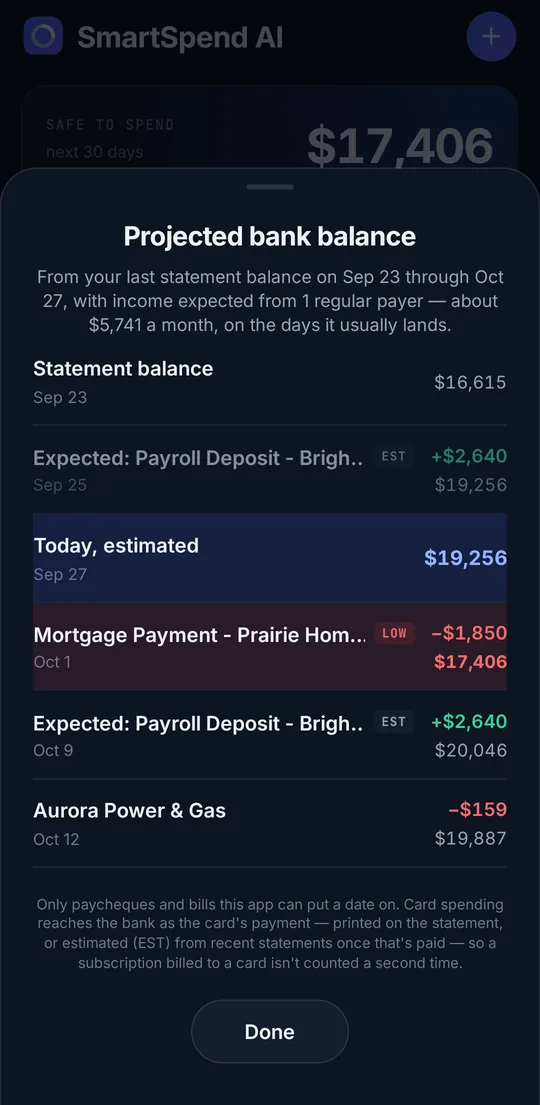
Rather than subtracting everything up to a single payday, it looks for the lowest point your balance reaches along the way. That catches the month where rent lands two days before the paycheque, even though the month as a whole balances out. The low point is your safe-to-spend number, recalculated every time you add a statement, with no bank login required.
Because it works from statements rather than a live connection to your bank, it won't know about the coffee you bought this morning, so keep your own small buffer on top. What it does see coming is the rent, the card payment and the regular bills, which is where most of the nasty surprises live.
Where this stops
None of this replaces an emergency fund, a real budget, or professional financial advice, and no single buffer can cover every surprise. It's one number that makes today's decision an honest one.
Bank balance terminology and transaction timing vary by institution.
Comments
Comment submissions will be available soon. In the meantime, you can reach out directly by email.