
Financial independence means your savings and investments can cover your living costs, so work becomes something you choose rather than something you need. For most people it sounds like a distant dream, and early retirement sounds even further away. But you don't have to want either one to benefit from saving as if you might.
Why save like you could retire early
You may change your mind. You might love your job today and feel very differently in fifteen years. Money you've saved keeps your options open; money you've spent closes them.
Your income isn't fully in your control. Layoffs, restructuring, health and family all have a say in how long you work. And if you'd ever like to freelance, start a business or go part-time, savings are what make a less predictable income survivable.
Early money does the heavy lifting. Suppose you invest $10,000 a year from 25 to 35 and then never add another dollar. Assuming a 5 per cent return after inflation, which is not guaranteed, it grows to roughly $544,000 by 65. Someone who waits until 35 and then invests $10,000 every year for 30 years ends up with about $664,000: only a little more, for three times the contributions.
It makes your priorities clear. Spending less forces you to decide what actually matters to you, and to find the things that make you happy that don't come with a price tag.
The ingredients
You don't need all of these. But the more of them you have, the sooner you get there.
Spend much less than you earn. Your savings rate matters more than anything else, and it works twice: every dollar you don't spend is a dollar invested, and a lower cost of living means you need less to be independent. A common rule of thumb is that you're financially independent at around 25 times your annual spending, so someone spending $40,000 a year would aim for about $1 million. Treat it as a starting point, not a guarantee.
Grow your income. It's very hard to save your way to independence on a low income, because some costs, like somewhere to live, can only be cut so far. Education, a trade, new skills and the occasional well-chosen job change are often the biggest lever you have.
Get your partner on board. This is more about shared values than earnings. If one of you is saving for freedom later and the other is spending on convenience now, neither plan works. Talk about what independence would mean for both of you.
Invest early, often and cheaply. Regular contributions to low-fee, broadly diversified funds, inside a TFSA, RRSP or FHSA where you can, and then leave them alone. Fees matter: a fund charging 2 per cent a year can cost you a large share of your growth over a working lifetime.
Close the leaks first. High-interest debt works against you as fast as investments work for you. Clear the credit cards and build an emergency fund before you invest seriously.
Nice to have, not required
Owning your home can protect you from rising rents over the long run, though it isn't automatically a better investment than renting and investing the difference. Rental property can add income, but it's a part-time job, not a passive investment. And a side income, from freelancing, consulting or a small business, can speed everything up.
Start with the next month, not the next 30 years
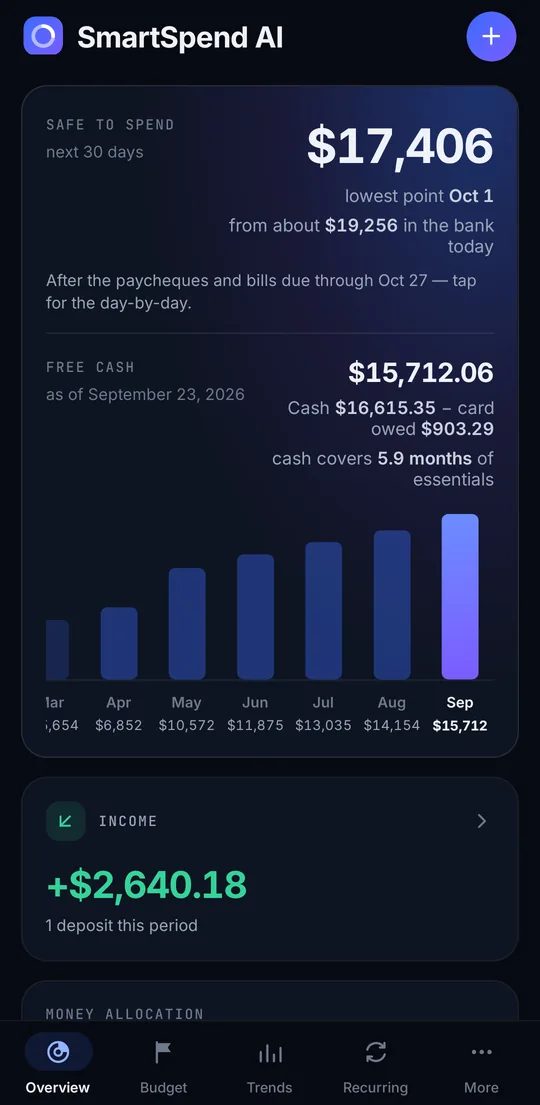
Financial independence is built one month at a time: a surplus that gets invested, a debt that gets paid off, a cushion that grows. SmartSpend AI shows you those building blocks from your own statements: your free cash each month, how many months your cash would cover your essentials, and a plan that clears the cards and builds the emergency fund before moving on to investing and your own goals.
Comments
Comment submissions will be available soon. In the meantime, you can reach out directly by email.